SMM1: due to the strict emission standards of the European Union and the influence of countries' consumption policies on new energy vehicles, the European electric vehicle market, including Germany and Norway, has accelerated since 2020. In 2020, pure electric vehicle sales in Norway accounted for 54.3% of the total car sales, making it the first country in the world to account for more than half of electric vehicle sales. Sales of pure electric vehicles in Germany tripled to more than 194000.
According to MarkLines, sales of electric cars in Europe reached 1.05 million from January to November 2020, and are expected to be 1.28 million in 2020, an increase of nearly 200% over the same period last year!
Taking into account the continuation of Europe's high subsidy policy for new energy vehicles in recent years, the continued layout of traditional car companies led by Volkswagen and Mercedes-Benz and the establishment of Tesla's European factory, we expect European sales to exceed 2 million next year, an increase of nearly 50 per cent year-on-year, 5.2 million in 2025, 45 per cent in CAGR in 6 years and more than 30 per cent in 2025, Anxin Securities said.
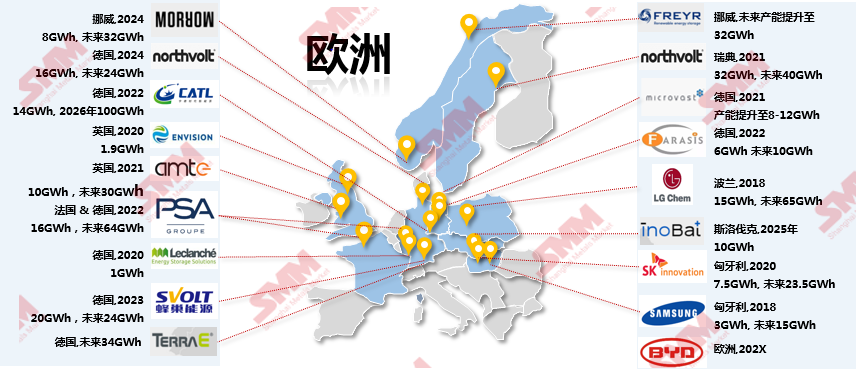
Under the background of the counter-trend growth of the European new energy vehicle market, upstream battery manufacturers may continue to benefit, and overseas battery factories will step up efforts to expand their production capacity. Here, SMM summarizes the layout and production capacity of overseas battery factories in 2020.
Panasonic: it is reported that Panasonic plans to enter Europe and build its first battery plant in Norway in an attempt to take advantage of the successful supply of Tesla to win more business from European automakers.
At the beginning of this month, InoBat is developing the world's first AI-powered battery research center and production line at Voderady, Slovakia, and the production line will begin producing the first smart battery in 2021. In addition, the company plans to spend 1 billion ou yuan to build a 10-GWh super battery plant in 2025 to provide state-of-the-art custom batteries for 240000 electric vehicles.
Verkor: according to reports, French battery start-up Verkor has announced plans to start a lithium battery factory with an annual production capacity of 16GWh in France, and expand its annual production to 50GWh according to the development of the market. It is understood that the initial investment of the project is about 13.14 billion yuan, and the European Institute of Sustainable Energy of the European Institute of Innovation and Technology, an innovation institution funded by the European Union, will provide financial support for it.
At the end of Northvolt:7, Nordic investment bank (NIB) signed a 10-year loan agreement with Sweden's Northvolt to finance a large lithium-ion battery manufacturing plant that Northvolt is building in Skelleftea, northern Sweden. The loan amount is US $44.3 million (39.53 million euros). Northvolt is currently building one of the largest battery factories in Europe in Skelleftea, Sweden. Once completed, Northvolt will produce lithium batteries up to 40gwh every year. These batteries are designed for automotive, electric energy storage and other industrial uses. The first part of the factory is scheduled to start production in 2021. Northvolt plans to start battery recycling in 2022.
In FREYR:7, it was reported that FREYR, a Norwegian battery manufacturer, announced plans to build the country's first lithium-ion battery superplant in Norway. The company has received 130 million Norwegian kroner ($13.85 million) in initial construction financing, which it said would facilitate faster construction and operation of the plant. FREYR hopes to start construction in the second quarter of 2021.
On March 29, SKI:6, SKI signed a $940 million (6.6 billion yuan) investment contract with the Georgia government to build its second U.S. battery manufacturing plant with an annual capacity of 11.7 GWh.
In Tesvolt:4, Tesvolt, a battery manufacturer, opened a new annual capacity plant for 255MWh in Wittenberg, Germany. The plant adopts semi-automatic production and can produce 1MWh energy storage system every day, with an annual output of 255MWH, which can be expanded to 1GWh in the later stage.
At the beginning of this month, Samsung SDI:3 reported that Samsung SDI, which converted to manufacturing lithium battery packs, had begun to expand the company's lithium-ion battery manufacturing plant in Goth, Hungary, and expected to invest 12 trillion won (about US $994 million) in Hungary by 2030, and gradually increase its capacity to 18 million cells per month, including about 6 million in plant 1 and 12 million in plant 2.
LG Chemistry: at the end of March, European Investment Bank (EIB) announced a $527 million loan agreement with Wroclaw Energy, a Polish-owned subsidiary of LG Chemical. The money will be used to build and operate highly automated and innovative manufacturing facilities for advanced lithium-ion batteries and battery-powered electric vehicle (BEV) batteries, accounting for approximately 1/3 of the total cost of Poland's lithium-ion battery production plant. The remaining 1 billion euros of investment comes from LG Chemical's own resources and other sources of financing. This investment will increase the annual production capacity of the LG Chemical Poland plant to about 65 gigawatt hours, making the Polish plant one of the largest lithium cell production plants in the world.
SMM believes that with the vigorous implementation of the electrification process in Europe, increased subsidies by various countries, as well as strict carbon emissions regulations and a ban on fuel vehicles, demand in the European new energy market is expected to increase significantly in the next five years. However, there is a serious shortage of local battery capacity in Europe, which mainly depends on the imports of Chinese, Japanese and South Korean battery enterprises. coupled with the small number of local battery enterprises in Europe and slow production expansion, it is expected that it will be difficult to meet the needs of new energy vehicle companies in the future. In this case, China, Japan and South Korea head battery companies seize the opportunity, the earliest South Korean battery companies LG Chemical and Samsung SDI have taken the lead in Poland and Hungary, followed by China's Ningde era, Honeycomb Energy, Funeng and other battery companies have begun to layout in Europe. The expansion of battery companies in the European market can not only speed up close cooperation with established European car companies, meet the R & D requirements of car companies, but also seize European market share ahead of time, expand global influence, and continuously increase future production capacity.
Related readings:
[SMM Analysis] the European electric vehicle market accelerates the outbreak of domestic power battery factories and highlights the advantages of overseas layout.
Seize the new energy tuyere! List of newly expanded power battery projects and production capacity of leading enterprises in 2020
[special topic on SMM] list of production expansion of leading enterprises of cathode materials in 2020